Pipeline review
As an AE, the part I liked least was keeping my pipeline current: digging through the CRM, my notes and old email threads, and guessing when a deal should move or close. So I built the thing I wanted back then, an agent that reads the week for me and tells me what changed.
Start from the deals I own
It starts by pulling every open deal I own from HubSpot: stage, amount, close date, the contacts, and when we last talked. I wrote the rules down as a skill so it behaves the same way every week, things like never pushing to HubSpot without my approval and never proposing close-lost just because a deal went quiet for a month.
## Hard Rules
1. **Never push to HubSpot without row-level approval.**
2. **Never send emails autonomously.** All follow-ups go to Gmail Drafts.
3. **Never invent evidence.** Every "this week" cell must cite a real
   Gmail thread, Calendar event, or call transcript.
6. **Closed-lost is conservative.** Cold periods of 30-45 days are
   normal. Drop probability instead.
13. **Check for upcoming meetings before recommending email actions.**Read the whole week, not summaries
Then for each deal it goes through Gmail, my calendar and the call transcripts from the past week and reads them in full. I made it pull full transcripts after a summary turned "4.9 a month" into $4,900 when the customer meant $499. Summaries also drop the stuff that matters most, like a question somebody asked that nobody answered.
Cards I approve one at a time
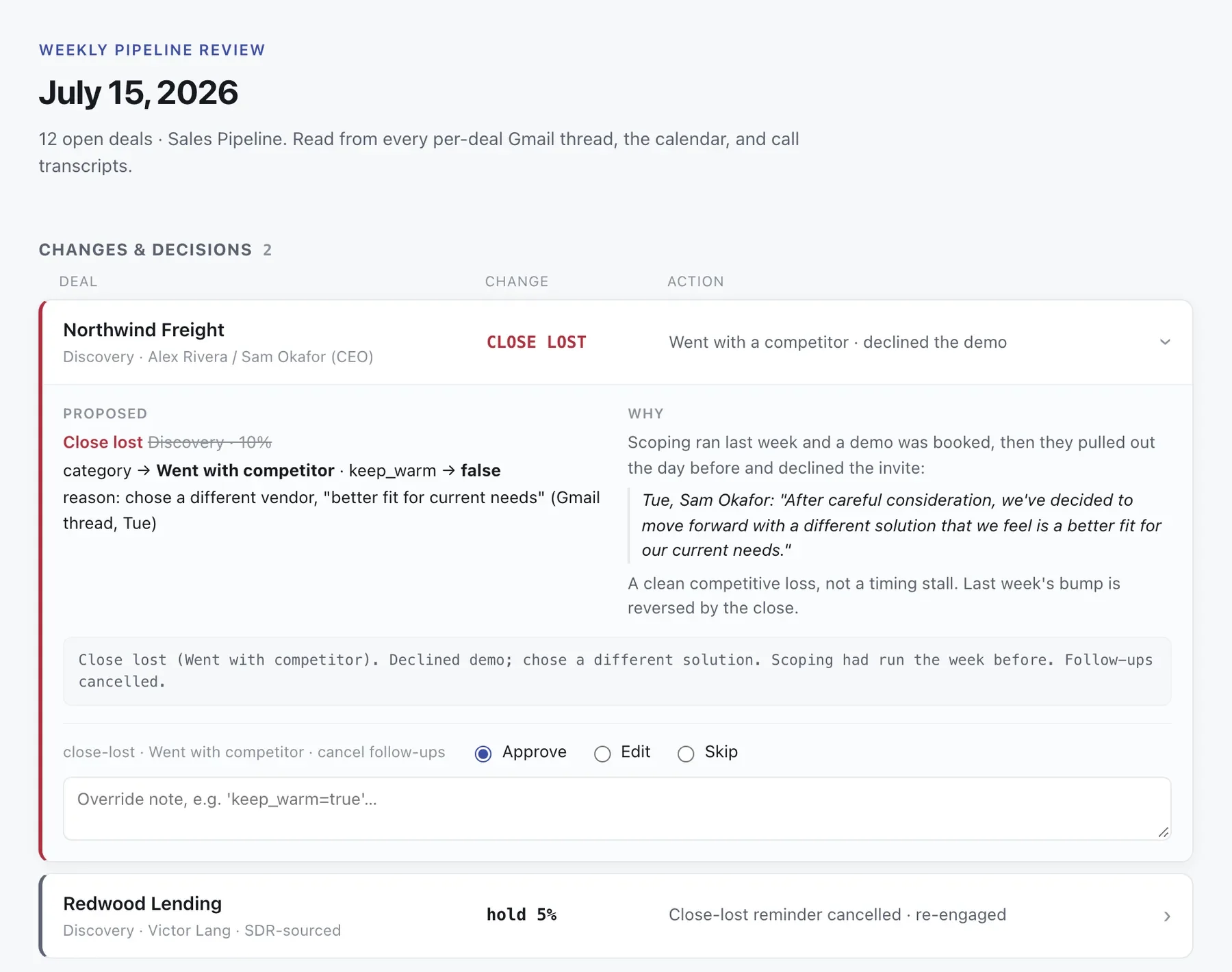
Each deal that needs a change gets a card with what it would change, why, a quote as evidence, and a draft note for the CRM. I go through and approve, edit or skip, and nothing touches HubSpot until I do. Follow-ups get written as Gmail drafts and reminders go on my calendar privately.
It remembers last week
A running worksheet keeps what I decided and what I pushed off, so it doesn't keep bringing back something I already said no to. If I were an AE somewhere else with this, Friday pipeline cleanup would mostly be a ten minute conversation: ask what changed, read the cards, approve most of them, fix a couple.
It runs each week, and it's set up so our CEO can run it on his own deals now that he owns sales.